
Izabela
Bran
Where stories come alive and emotions find their voice
01
about me
Beginning
The first book
My Career
ABOUT ME
my biography
Izabela is an emerging writer who has been writing poetry and stories since childhood, using language to hold emotions too heavy to speak aloud.
Her work resonates with those who feel deeply, give endlessly, and are learning that their softness is not weakness, but a form of strength. Through her poetry, she seeks to offer recognition, understanding, and the quiet comfort of being seen.
Izabela is preparing to publish her first book — a story told through a collection of poems. This debut collection marks her first step into the public literary space as a writer.
BEGINNING
my biography
My journey with poetry began quietly, long before I imagined sharing my words with others. Writing started as a personal refuge — a way to capture thoughts, emotions, and fleeting moments that often remain unspoken.
Over time, poetry became more than a private expression; it became a way to understand the world and the subtle depth of human experience. Influenced by classical literature and the timeless voices of poets, I discovered the power that simple words can hold.
What once began as a personal dialogue with the page slowly grew into a desire to share these reflections with readers. My first poetry collection marks the beginning of that journey.
THE FIRST BOOK
my biography
Poppies Grow in the Wilderness was born from silence — from the things we never say, the pain we carry alone, and the quiet hope that healing is still possible.
This debut poetry collection explores heartbreak, vulnerability, and the quiet strength that emerges from emotional wounds. The central message is simple yet powerful: even in moments of deep pain, there is resilience.
These poems do not romanticize suffering. Instead, they reflect the courage it takes to survive it and the slow, imperfect path toward healing.
The poppy, a symbol of resilience, is known to bloom even in the harshest places. In many ways, so do we.
MY CAREER
my biography
As an emerging poet, Izabela is beginning her journey in the literary world with her debut collection of poems, Poppies Grow in the Wilderness.
While this is her first published work, she has been writing poetry and short stories since childhood, exploring themes of emotion, resilience, and the quiet strength found in everyday life.
Izabela is committed to continuing her creative journey, writing new poems, sharing her work with readers, and connecting with other writers and poetry communities. This debut collection marks the first step in what promises to be a long and meaningful literary career.
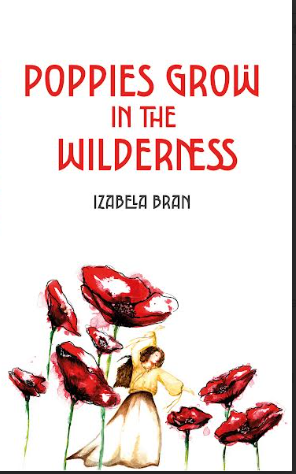
Upcoming Event
BOOK LAUNCH
Poppies grow in the wilderness
SATURDAY 08 aug 17:00 AT
CENTRUL SINELUI
BUCURESTI
00
Days
00
Hours
00
Minutes
00
Seconds
03
testimonials
Early Readers

These poems feel deeply personal yet universally relatable. Each line carries emotion that lingers long after you finish reading.
Ana
March 25, 2026

Poppies Grow in the Wilderness is a quiet but powerful collection. It speaks about pain, healing, and the courage to remain soft in a difficult world.
Lavinia
March 30, 2026

Izabela Bran’s poetry captures emotions many people struggle to express. The poems feel honest, vulnerable, and beautifully reflective.
Alex
March 28, 2026
Stories
Between the lines
04
On poetry
"We don't read and write poetry because it's cute. We read and write poetry because we are members of the human race." — Dead Poets Society
Yes, I am writing a blog on poetry. And yes, I am writing a blog on poetry.
I wrote my first poem when I was eight years old. I was an early bloomer. I learned to read and write when I was six, so by the time I was eight I already had my first diary. I didn't know I was writing poems. I thought I was just writing in my diary.
Later, when I started school, I learned what a poem was, what a short story was, what a novel was. I also learned that poems had rules. They had to rhyme, follow a rhythm, use metaphors, and fit into a structure.
I think that's when I lost interest.
Sometimes I wonder how many children lose interest in poetry for the same reason. How many stop writing because it suddenly becomes too difficult, too full of rules, too cryptic to enjoy. I wonder how many beautiful voices are lost before they even have the chance to be heard.
I think freedom is what makes a poem shine, not the rules, the imposed rhythm, the sound, or even the metaphors. Those things are part of poetry, but they are not poetry itself.
When I wrote Poppies Grow in the Wilderness, the main idea behind it was simple. I wanted to be understood by everyone who wanted to read it, no matter their age. I challenged myself to create something with flow, something that tells a story but still feels lyrical and emotional. I wanted it to feel less like solving a puzzle and more like listening to a close friend telling you something they have carried for a long time.
That has always been my idea of poetry.
To be felt.
To be understood.
I think the rules around poetry can become a box. We put our ideas and feelings inside it because we want to be accepted, less judged, or published. I wanted to step outside that box and make my own rules. My own way of telling a story. My own way of expressing emotion.
We live in a world of systems, and every system has a way of deciding who belongs. Poetry is no different.
But we don't all live the same life.
We don't all love the same way.
We don't all grieve the same way.
So why should we all write the same way?
I think it's sad that, in a world full of possibilities, we still try to fit something as personal as poetry into one shape. A poem shouldn't need to be explained before it can be felt. If someone reads your words and finds a piece of themselves in them, then the poem has already done its job.
People often ask what poetry is supposed to do.
I don't think it is supposed to do anything and everything at the same time.
I have a few favourite lines from poems, but I always come back to these by Robert Frost:
I shall be telling this with a sigh
Somewhere ages and ages hence:
Two roads diverged in a wood, and I—
I took the one less traveled by,
And that has made all the difference.
midnight library
I recently finished The Midnight Library, and it opened my eyes… my many eyes.
It’s actually the first novel I’ve read in a while. For the past two years, I’ve mostly been reading philosophy and psychoanalysis (and I’m still trying to make sense of Freud and all his ideas).
Coming back to The Midnight Library… 🤭
Sometimes I realize I’ve put myself inside a box and convinced myself that the box is my only option. I paint it, decorate it, add glitter and sparkle, but at the end of the day, it’s still a box.
Maybe we don’t always live the life we truly want. Maybe we live the life we believe is possible for us, the life that feels safe, the life we think we deserve. But a box is just a box. It isn’t the entire universe.
What I loved about The Midnight Library is how it blends the real with the unreal. It reminded me of something I experienced through past life regression therapy.
For those who aren’t familiar with it, past life regression is a therapeutic technique, usually guided under hypnosis or deep relaxation, in which people explore memories that they may interpret as experiences from previous lives. Some therapists use it as a way to access emotions, recurring patterns, or subconscious beliefs, regardless of whether those memories are understood as literal or symbolic.
I had my first session two years ago, when I had reached one of the lowest points in my life and couldn’t see any light ahead. I was fortunate to work with a therapist who used different methods to help me go beyond what traditional talk therapy alone could offer.
Since then, I’ve had many more regression sessions. Whether those experiences were memories, metaphors, or simply my subconscious speaking, they’ve helped me understand myself better. They’ve shown me possibilities I couldn’t see before. My life has changed in many ways, and little by little, it feels like the right people have started finding their way into it.
To me, The Midnight Library carries a similar message: there are infinite possibilities, infinite versions of who we could become. But no one else holds the wand. We do. We are the creators of our own story. We are the magicians.